
Mobile app marketing is everything you do to get the right people to find your app, download it, and keep using it. That covers the period before launch, the week you go live, and every month after that.
It sounds like a lot because it is. But most indie builders do not need to do all of it at once. They need to understand what the pieces are, pick the ones that match where they are right now, and build from there.
This guide covers the full picture in plain language, with practical examples and a clear direction at the end.
Table of Contents

- What mobile app marketing actually means
- The 3-3-3 rule explained simply
- How to promote your app, step by step
- The main marketing channels and how they compare
- Short-form video: why it matters more than people expect
- Common marketing questions worth asking before you start
- A simple recommendation for indie builders
What mobile app marketing actually means
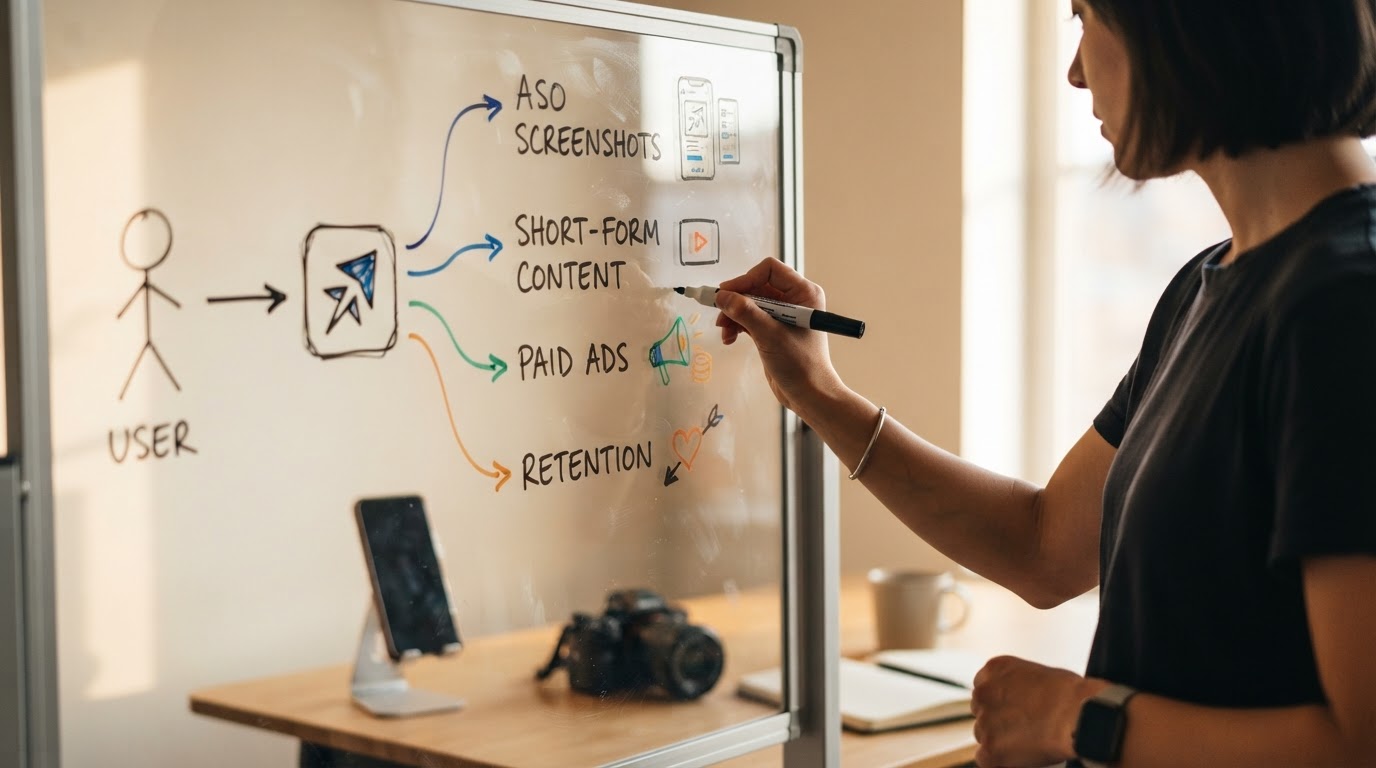
Mobile app marketing is not just running ads. It includes everything that touches user acquisition and retention: your app store listing, your social content, your paid campaigns, your onboarding, your push notifications, and your word-of-mouth strategy.
Most guides split this into three phases:
Pre-launch. Building awareness before anyone can download the app. This includes teaser content, landing pages, waitlists, and getting your app store page ready.
Launch. Getting downloads in a short window. Press mentions, social posts, promotions, and paid ads all belong here.
Post-launch. Keeping people who downloaded the app engaged, and finding more people like them. This is where most of the long-term work happens.
The reason mobile app marketing gets its own name, separate from general digital marketing, is that the stakes are different. Mobile users decide within seconds whether to keep an app. The barrier to deletion is almost zero. So the marketing has to earn attention early and earn trust continuously.
The 3-3-3 rule explained simply
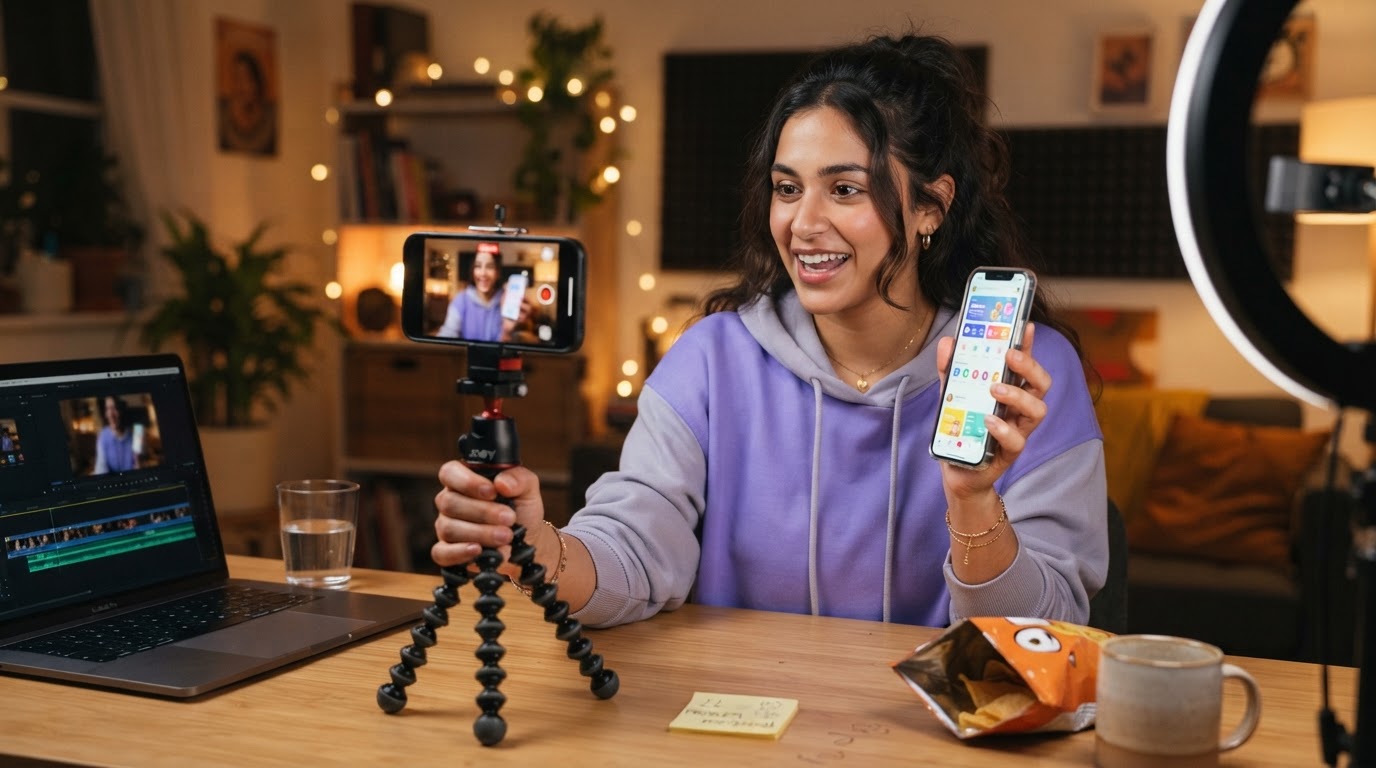
The 3-3-3 rule is a practical framework that some mobile marketers use to structure their thinking. It is not a formal standard, but it is useful shorthand.
The idea is:
- 3 seconds to stop the scroll and earn attention
- 3 minutes to show enough value that a user stays in the app after downloading
- 3 days to create a habit strong enough that they come back on their own
Each stage has different jobs. The first 3 seconds belong to creative, specifically your ad or organic content hook. The first 3 minutes belong to onboarding and product clarity. The first 3 days belong to habit loops and push notifications.
Indie builders often spend most of their energy on the creative and almost none on onboarding or retention. The result is good download numbers and poor long-term retention. Both sides need attention.
How to promote your app, step by step
There is no single path that works for every app. But there is a reasonable order that keeps effort from going to waste.
Step 1: Know who actually needs this
Before writing a single word of copy or filming a single clip, get specific about the person who benefits most from the app. Not "everyone who has a phone." One kind of person, with one kind of problem, who would feel relieved the moment they understand what the app does.
A fitness app is not for "people who want to get fit." It is for someone who works out without structure and keeps losing progress between gym sessions. That specificity changes the entire tone of every piece of content.
Step 2: Get the app store listing right
The app store is a search engine. People type in problems and look for solutions. Your title, subtitle, screenshots, and description all need to reflect the actual problem being solved.
Screenshots are the most overlooked part. Many apps use generic device mockups with vague captions. The better approach is to show the result the user gets, with text overlays that speak to the problem directly.
Step 3: Build a small content engine
Organic content on TikTok, Instagram Reels, and YouTube Shorts is the most accessible channel for an indie builder with a limited budget. It costs time, not money, and it compounds. A video that performs well in month one can still bring in installs six months later.
The format that works best for apps is simple: show someone reacting to a problem, then show the app solving it. Hook first, product second. That structure works because it mirrors how the viewer is already thinking.
If producing consistent video content sounds exhausting, that is worth addressing directly in the tools section below.
Step 4: Run paid ads only once you have creative that works
Paid ads on Meta, TikTok, and Google are not a substitute for figuring out what your creative should say. Running paid traffic to an ad that does not convert is just a faster way to lose money.
The better sequence is to post organically, see which hooks and formats get the most engagement, and then put paid budget behind the pieces that already proved themselves.
Step 5: Work on retention from day one
Downloads are a vanity metric if nobody opens the app a second time. App store rankings, ad costs, and word-of-mouth all improve when retention is healthy.
Retention tactics include better onboarding flows, timely push notifications, in-app milestones, and re-engagement campaigns. The simplest version of this is making sure new users get one clear win inside the app within the first three minutes.
The main marketing channels and how they compare
Understanding your options makes it easier to choose the right starting point rather than trying everything at once.
App Store Optimization (ASO)
ASO is the process of making your app store listing rank higher for relevant searches. It costs nothing except time and has long-term compounding effects.
Focus on: your app name, keywords in the subtitle and description, a strong icon, and screenshots that tell a story.
ASO is not optional. Even if all your growth comes from social, people who hear about your app will check the store listing before downloading. A weak listing kills conversions from every other channel.
Organic social content
TikTok and Reels are the highest-leverage free channels for most mobile apps right now. The algorithm rewards content that earns attention fast, regardless of follower count. A new account with one great video can reach tens of thousands of people who have never heard of the app.
The challenge is consistency. One good video is not enough. Most app builders need a steady cadence of content, which is where production workflow becomes the real bottleneck.
For more on using TikTok for app growth, the TikTok UGC ultimate guide for brands covers this in detail.
Paid social ads
TikTok Ads and Meta Ads are the two main platforms for mobile app campaigns. Both support app install objectives that tie your spend directly to download events.
The advantage of paid is speed. The disadvantage is cost and the learning curve around creative testing.
Paid works best when: you have a clear understanding of your target audience, you have multiple creative variations to test, and you have tracked your cost-per-install target against your revenue per user.
Without those three things, paid advertising tends to feel like a money pit.
Influencer and creator partnerships
Working with creators who already have an audience that matches your users can be effective, especially for the initial credibility boost. Micro-influencers (accounts with 10k to 100k followers in your niche) tend to have better engagement rates and lower costs than larger accounts.
The catch is that influencer deals require outreach, negotiation, creative direction, and follow-up. For a solo founder, that process can eat weeks of time for uncertain return.
A lighter version of this is UGC-style content, where the creator style is replicated without requiring a formal partnership agreement.
User-generated content (UGC)
UGC is content that looks like it came from a real user, even when it is produced intentionally for an ad. It performs well because it bypasses the instinctive skepticism most people have toward polished brand advertising.
For app marketing specifically, UGC that shows a real reaction to the app, a screen recording of the product in use, or a before-and-after result tends to outperform traditional ad formats.
There is a whole category of tools and approaches for creating UGC at scale. The guide to AI UGC video creation covers how that process works for indie builders.
Email and push notifications
These are retention channels, not acquisition channels. They are most useful after someone has already downloaded and used the app at least once.
A simple email sequence that onboards new users and resurfaces the app's main value within the first week can meaningfully improve 30-day retention.
Content marketing and SEO
Blog posts, tutorials, and comparison pages can drive steady organic traffic over time. The keyword this article is built around, "mobile app marketing," is a good example. Ranking for terms related to what your app does or solves brings in people who are already researching the problem.
SEO takes time to compound, but it has zero variable cost once content is published.
Short-form video: why it matters more than people expect
Short-form video is not just a trend. For mobile apps, it is one of the most direct paths from stranger to install.
Here is why it works particularly well for apps. Unlike physical products, apps are invisible. You cannot photograph the experience of using one. You have to show it in motion. A well-edited 30-second video can convey what takes five paragraphs to describe.
The structure that consistently works is:
- Hook. Something that stops the scroll in the first one to three seconds. This could be a reaction, a surprising statement, a relatable problem, or a bold visual.
- Bridge. A brief moment that connects the hook to what the app does.
- Demo. A clean screen recording or on-screen demonstration of the app solving the problem.
- Close. A low-friction call to action, usually just a text overlay pointing to the app.
The problem most indie builders run into is that producing even one decent video takes hours. Producing ten variations for testing takes days. And without testing multiple hooks and formats, it is hard to know what actually resonates with the target audience.
This is where a production workflow matters as much as the creative strategy itself. If making each ad requires opening a video editor, assembling clips manually, adjusting text, syncing music, and exporting for vertical format, then the friction of the process will limit output more than any creative challenge.
Tools like ClipStitchr are built specifically to reduce that friction for indie builders. The idea is to upload hook clips and a product demo once, then let the tool pair them and generate finished vertical ads for review, without rebuilding the same timeline by hand every time. Scores on individual clips and finished stitches give a quick read on what to fix before anything goes live.
For a real example of this working in practice, the Guppy fitness app case study shows how one app builder used consistent short-form content to grow organic views without a large production team.
What to do when the clip library is thin
One recurring problem for solo builders is running out of usable footage. Filming new clips takes time, and hiring UGC creators costs money. Two middle-ground options worth knowing about:
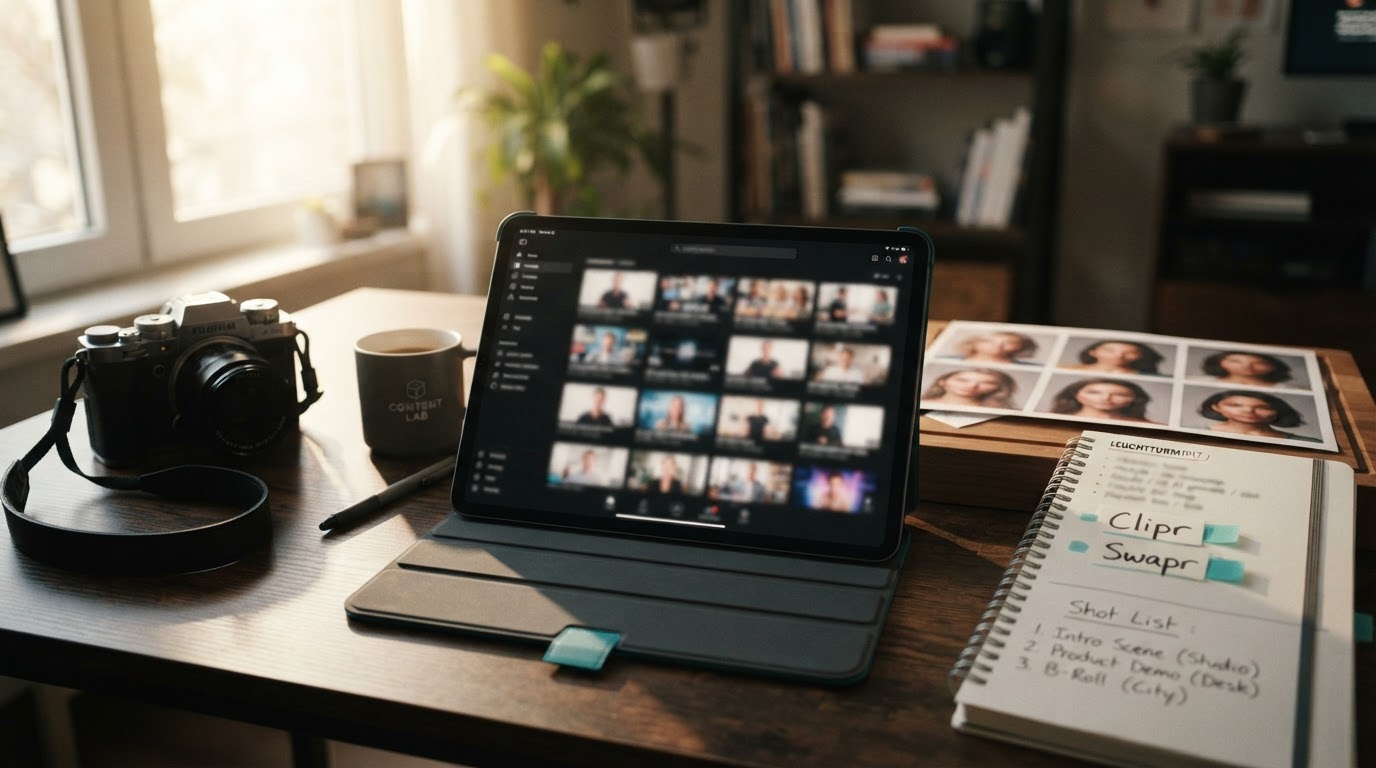
AI-generated UGC. Tools like Clipr (built into ClipStitchr) let builders generate short reaction and b-roll clips using avatar photos, without filming anything. The results are not indistinguishable from real-person footage, but they are usable and fast to produce.
Real-person UGC networks. Platforms like DansUGC connect builders with real creators who film authentic-looking content. This is a better option when the clips need genuine human presence and real reactions.
Both approaches can fill gaps in a content library without requiring a dedicated film shoot.
Getting views on new content
Posting well-made content is necessary but not sufficient. A few things consistently help new videos get traction faster:
- Posting at times when the target audience is active
- Using relevant but not oversaturated hashtags
- Engaging with comments quickly after posting
- Repurposing content across TikTok, Reels, and YouTube Shorts from the same batch
The guide to getting 1,000 views on TikTok fast covers some of the tactical details around the early distribution window.
If TikTok is not the right fit for a particular app or audience, the top TikTok alternatives for small business marketing lays out other short-form platforms worth considering.
Common marketing questions worth asking before you start
One pattern that shows up in most unsuccessful app launches is that builders skip the questions and jump straight to execution. The execution then points in the wrong direction, and effort gets wasted.
Here are the questions worth sitting with before spending significant time or money on any channel.
Who is the one person this app helps most?
Not a demographic. A specific situation. Someone who has a particular problem, has probably already tried one or two solutions that did not work, and would feel immediate relief when the app solves it properly.
What does the user understand in the first 30 seconds of using the app?
If the answer is "not much," the onboarding is a problem. The first 30 seconds inside the app are more important than almost any ad.
What would make a user recommend this app to a friend without being asked?
Word of mouth is still the highest-converting acquisition source for consumer apps. The app needs to do something surprising, delightful, or unusually useful to earn that kind of recommendation. If nothing comes to mind, that is a product signal worth addressing before increasing marketing spend.
Which channel can be sustained consistently for six months?
The honest answer for most solo builders is not "all of them." Picking one or two channels and doing them consistently tends to outperform spreading effort thin across five channels with no depth in any.
What does a successful install actually look like?
This means defining what happens after the download. Does the user complete onboarding? Do they reach a core feature? Do they come back on day two? Without a definition of success, it is impossible to know whether the marketing is working.
What does the cost-per-install need to be for the business to make sense?
This is only relevant for paid campaigns, but it is important. If the average revenue per user over their lifetime is $8, and a paid install costs $6, the economics only work if retention is very strong. Running paid campaigns without this math is guessing.
A note on the four types of mobile applications
A common question that comes up in mobile app marketing research is about the four types of mobile applications. The standard categorization goes like this:
Native apps. Built specifically for one platform, iOS or Android, using the platform's native tools. They tend to have the best performance and access to device features.
Web apps. Essentially mobile-optimized websites that behave like apps but run in a browser. No app store required.
Hybrid apps. Built with web technologies but packaged inside a native wrapper so they can be distributed through app stores. A common middle ground for teams that want cross-platform coverage without building twice.
Progressive web apps (PWAs). Web apps that use modern browser features to behave more like native apps, including offline access and push notifications.
The marketing implications vary slightly. Native and hybrid apps on major app stores benefit heavily from ASO. Web apps and PWAs rely more on SEO and direct traffic. But the core marketing principles, clear positioning, a strong hook, and consistent content, apply across all four.
A simple recommendation for indie builders
If this is all starting to feel like a long list of things to do, here is the simplified version.
Start with three things:
- Make the app store listing honest and specific. Replace vague language with the exact problem the app solves and the exact result the user gets.
- Post short-form video content consistently, at least two to three times per week, using the hook-then-demo structure. Do not wait until the videos feel perfect.
- Track one retention metric from day one. Even something as simple as how many users open the app on day two gives a signal about whether the onboarding is working.
Everything else, paid ads, influencer deals, email sequences, content marketing, can be layered in as the basics stabilize.
The builders who get the most out of short-form video tend to solve the production bottleneck first. When creating a new ad takes three hours, it is hard to produce enough volume to find what works. When it takes fifteen minutes, iteration becomes possible.
That is the core problem ClipStitchr is built to solve. Upload clips and a product demo once, build a reusable library, and produce finished vertical ads without rebuilding the same workflow every time. Scoring tools flag weak openers and pacing issues before anything goes live. Templates save structures that worked so the next batch does not start from zero.
There is a 14-day free trial with no credit card required. For indie builders who want to get consistent with short-form video without letting production eat the week, it is worth trying early in the process rather than after months of manual editing.