TikTok has over a billion active users and one of the most powerful discovery algorithms of any social platform alive today. A video from an account with zero followers can reach hundreds of thousands of people if it earns attention in the first few seconds. That is genuinely different from how most platforms work, and it is exactly why TikTok marketing deserves a real strategy rather than a few rushed posts.
The short answer to how to market on TikTok is this: make short videos that earn attention fast, post them consistently, test a lot of variations, and use the data to figure out what your audience actually responds to. That sounds simple. The details are where most people get stuck.
This guide walks through everything that matters, from setting up correctly to creating content that performs to running paid ads and building a repeatable workflow.
Table of Contents
- Why TikTok marketing is different
- Set up your TikTok presence properly
- Understand the TikTok algorithm
- What content actually works on TikTok
- The hook is everything
- How UGC fits into your TikTok strategy
- TikTok ads explained
- Building a posting workflow that does not break down
- How to measure what is working
- Common TikTok marketing mistakes
- Tools that help
Why TikTok marketing is different
Most social platforms are built around followers. Grow an audience first, then your posts reach them. TikTok flips that. The For You Page (FYP) serves content based on interest signals, not on whether someone follows you. A new account with one well-made video can outperform an established account that posts mediocre content.
That changes the strategy entirely. On TikTok, the content itself is the distribution. Good videos earn reach. Weak videos disappear quickly. That means the job is not just to post regularly; it is to post things that earn attention in the first one or two seconds and keep it through to the end.
For indie app builders and mobile marketers, this is genuinely useful. You do not need a large following or a big media budget to get your product in front of people. You need a clear hook, a relevant message, and enough volume to find what resonates.
Set up your TikTok presence properly
Before creating content, spend twenty minutes getting the basics right.
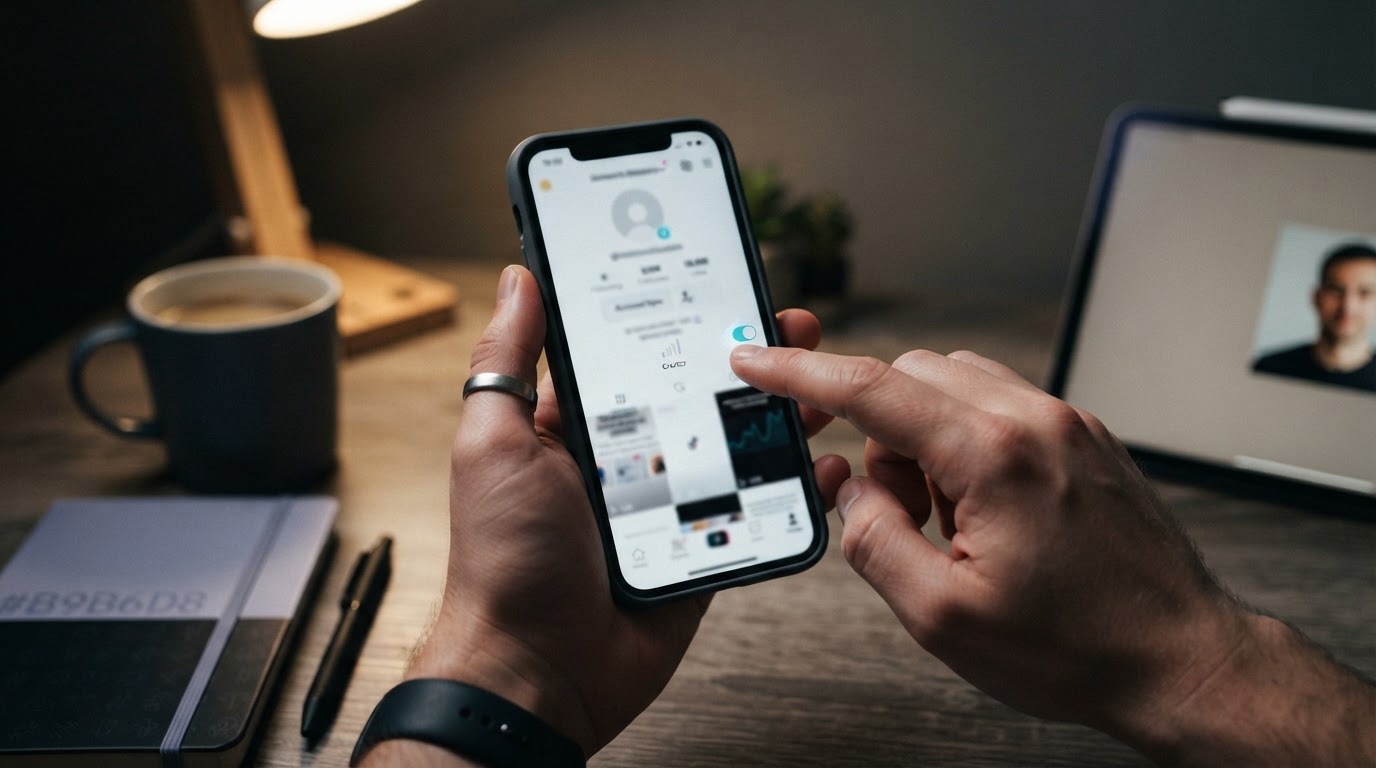
Switch to a Business Account. A Business Account unlocks TikTok Analytics, the ability to run ads, and access to the Creator Marketplace if you want to work with influencers later. The tradeoff is that Business Accounts cannot use trending commercial sounds, so many creators prefer a Creator Account for organic content. If ads are part of the plan, a Business Account is the right choice.
Write a clear bio. The bio has 80 characters. Use them to say exactly who the account is for and what it offers. "Fitness app for people who train at home" beats "Check out our app!" by a wide margin. Add a link if the account is eligible.
Set a consistent profile photo. For a brand or app, use the logo or a clean product screenshot. For a personal creator building an audience around their expertise, a clear headshot works better.
Connect to other platforms. Link Instagram and YouTube if they exist. Cross-promotion brings existing audiences to a new TikTok presence faster than starting cold.
Understand the TikTok algorithm
The TikTok algorithm decides which videos the FYP serves to which people. Understanding how it works helps you make better decisions about content.
The algorithm weighs several signals:
- Watch time and completion rate. If people watch a video all the way through, or rewatch it, TikTok treats that as a strong signal that the content is worth showing to more people.
- Engagement. Likes, comments, shares, and saves all matter. Saves and shares are weighted more heavily because they indicate genuine value.
- Early performance. TikTok shows a new video to a small test audience first. If that group responds well, the video gets pushed to a larger one. If it does not, the reach stays limited.
- Relevance signals. Captions, sounds, hashtags, and on-screen text help TikTok understand what a video is about and who it should reach.
The practical takeaway is that every video competes on its own merits. A video posted today does not benefit from yesterday's video. That is why testing volume and hook quality matter more than posting schedule.
What content actually works on TikTok
There is no single formula, but there are patterns that show up consistently in well-performing TikTok content.
Teach something fast. Tutorial content performs well because people save it and share it. A short video that solves a specific problem ("why your screen time app keeps resetting") or explains something clearly ("the difference between habit tracking and goal tracking") earns disproportionate reach.
Show a result. Before-and-after videos, transformations, and "look what happened when I tried this" formats are native to TikTok. For app marketers, showing what the product actually does in a real context tends to outperform polished demo reels.
React or respond. Duets, stitches, and response videos tap into existing conversations. Finding a video your audience is already watching and responding to it puts your content in front of that same audience.
Be specific, not broad. A video titled "best productivity apps" is competing with thousands of others. A video titled "the only app that actually fixed my morning routine" is more specific and more believable.
Use native formats. Vertical video, on-screen text, trending sounds where the license allows, and genuine voiceover all feel natural on TikTok. Repurposed horizontal content or polished TV-style ads tend to underperform unless they are exceptionally good.
The hook is everything
The first one to three seconds of a TikTok video determine whether someone keeps watching or scrolls. That is not an exaggeration. On a platform where the next video is one swipe away, weak openers lose almost everyone before the point lands.
A good hook does one of a few things:
- Makes a specific, slightly surprising claim ("I deleted Instagram for 30 days and my app downloads tripled")
- Shows something visually unexpected before any words appear
- Asks a question the target viewer immediately wants answered ("Why does your fitness app have a 90% day-seven dropout rate?")
- Starts in the middle of action, not at the beginning of an explanation
On-screen text helps. Many TikTok users watch without sound, especially in public. Adding text that mirrors or extends the spoken hook captures those viewers too.
The hook is also where most marketers give up too early. One video with a weak hook is not enough data. Testing five or ten different openers for the same core message is standard practice for anyone getting real results.
For a deeper look at what drives early TikTok views, the how to get 1000 views on TikTok fast guide breaks down the mechanics clearly.
How UGC fits into your TikTok strategy
User-generated content, or UGC, is one of the most effective content formats on TikTok. It looks like real people talking about real experiences rather than polished brand messaging. That matters because TikTok audiences are sharp at detecting content that feels like an ad, and they scroll past it quickly.
UGC for TikTok typically follows a simple pattern: a person speaks directly to camera, shares a reaction or result, and the product appears as a natural part of the story. The hook is personal. The demo is embedded in the narrative. The whole thing feels like something a friend might send you rather than something a brand produced.
For app builders and mobile marketers, UGC works particularly well because it can demonstrate the product in real-use contexts that a polished product demo cannot replicate. Someone saying "I used this app every morning for two weeks and here is what changed" is more credible than a screenshot walkthrough.
The challenge for small teams is volume. A single UGC clip will not tell you much. Testing multiple hooks, multiple creators, and multiple angles is where the signal comes from. How UGC works on TikTok covers the mechanics in more detail, including how brands source and repurpose UGC for ads.
If creating a large library of UGC feels out of reach, AI-generated UGC is now a practical option. The how to create UGC videos with AI guide is a good starting point for understanding what is possible and where the limits are.
TikTok ads explained
Organic content builds brand and earns discovery. Paid ads accelerate it. Most serious TikTok marketing strategies eventually use both.
Ad formats worth knowing
In-Feed Ads appear in the FYP between organic videos. They autoplay and look like normal TikTok content. This is where most app marketers start because the format is familiar and the targeting is relatively precise.
TopView Ads appear when someone opens the app. They are expensive and better suited to large campaigns with brand awareness goals.
Spark Ads let brands boost existing organic posts or UGC from creators. This is a particularly useful format because the boosted content already has social proof (likes, comments, shares) attached to it.
Collection Ads and Dynamic Showcase Ads are more suited to e-commerce, but app developers occasionally use them for showing multiple features or screenshots.
For most indie app builders, In-Feed Ads and Spark Ads are where to start.
The structure of a good TikTok ad
TikTok's own research consistently shows that ads formatted like organic content outperform polished commercials. The platform calls this "TikTok-first creative." In practice, that means:
- Vertical 9:16 format
- A hook that earns attention before it asks for anything
- Captions or on-screen text
- A clear call to action (CTA) that appears after the hook earns the viewer, not before
- Runtime of 15 to 30 seconds tends to perform well for app installs
The UGC-style ad, where a creator talks directly to camera and demonstrates the product naturally, is the most consistently effective format for app marketers on TikTok.
Targeting on TikTok
TikTok Ads Manager offers audience targeting by interest, behavior, demographics, and custom audiences (including lookalike audiences built from existing customer lists or app users). For app install campaigns, the Mobile App Install objective connects directly to the App Store or Google Play.
The most common mistake with TikTok ad targeting is over-restricting the audience. TikTok's algorithm is good at finding the right people when it has enough room. Starting with broader targeting and letting the platform optimize often produces better results than narrowing down to a very specific demographic from day one.
Building a posting workflow that does not break down
Consistency matters on TikTok, but the kind that breaks down after two weeks does not help anyone. The real goal is a workflow that produces content without requiring heroic effort every single time.
Batch your content creation
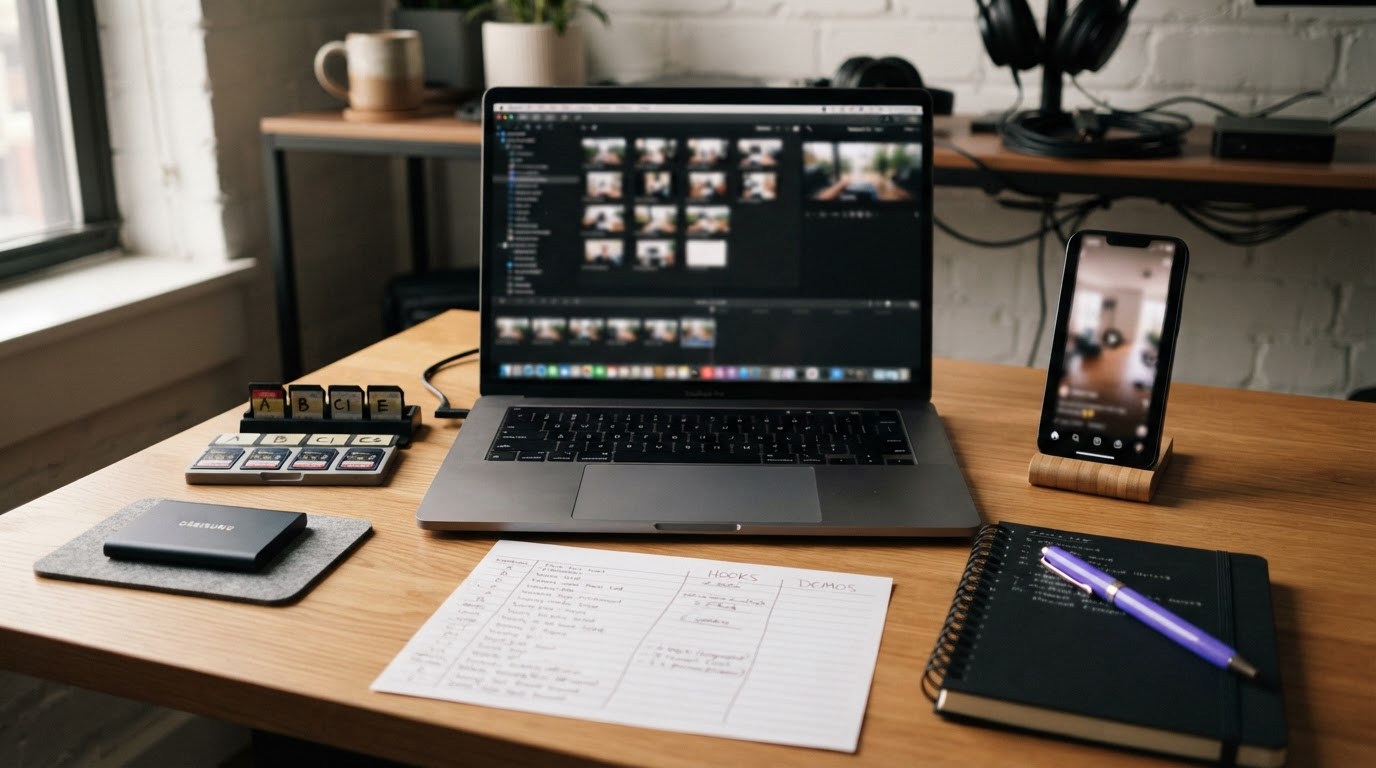
Recording ten clips in one session is far more efficient than recording one clip per day. The setup, the lighting, the energy, and the focus are already there. Batching also means the account keeps posting even during weeks when there is no time to record.
Separate hooks from demos
A single product demo can pair with many different hooks. Record the demo once, cleanly. Then create multiple hook clips that address different angles, audiences, or problems. This is a much faster way to produce volume than starting from scratch every time.
This is also the core idea behind how ClipStitchr works. Upload a product demo once, build a library of hook clips, and the tool pairs them together into finished vertical ads without rebuilding the same timeline by hand every session. For app builders posting multiple ads per week, that removal of repetitive editing is where the time savings actually land.
Keep a content library
Clips, demos, finished ads, and drafts all need somewhere to live. The common alternative is folders scattered across a hard drive, a camera roll, and a Dropbox that nobody organized correctly. That is fine until the account needs to scale or the next person on the team cannot find anything.
A proper library means every clip is findable, tagged, and ready to use. It also means there is a record of what was already used so the same clip does not run twice in the same week.
Score content before it posts
Not every clip is worth building an ad around. Weak openers, awkward pauses, unclear moments, and poor vertical framing all reduce performance. Catching these issues before the ad runs saves both ad spend and the slot it would have occupied.
ClipStitchr's clip and stitch scores give a quick read on where a clip is likely to lose viewers before it goes live, including notes on the hook, pacing, and fit for short-form formats. That kind of pre-flight check is easy to skip but consistently useful.
Use templates for formats that work
When a particular ad structure performs well, rebuilding it from memory for the next batch is wasteful. Saving the structure as a template means the next round starts from a working foundation, not a blank canvas.
How to measure what is working
TikTok Analytics (available on Business and Creator accounts) provides video-level data that is actually useful for decision-making.
Watch time and average watch percentage. This is the most direct signal of whether the hook and pacing are working. A video with a 15% average watch percentage has a problem early. A video with a 70% average watch percentage earned real attention.
Traffic source breakdown. TikTok shows what percentage of views came from the FYP, from followers, from search, and from profile visits. FYP traffic means the algorithm is distributing the content. High follower traffic on a new video means the audience is engaged but the algorithm has not picked it up yet.
Shares and saves. These are higher-intent signals than likes. A video people save or share is one they found genuinely useful or worth sharing.
Click-through rate on ads. For paid campaigns, CTR measures how well the ad creative earns a click. Low CTR usually means the hook or CTA needs work, not that the targeting is wrong.
Install cost and day-seven retention. For app marketers, installs from TikTok need to be connected to post-install behavior. An ad that drives cheap installs but terrible retention is not a successful ad. Connecting TikTok Ads to an attribution tool (AppsFlyer, Adjust, or similar) makes this visible.
Common TikTok marketing mistakes
Posting once and waiting. One video proves almost nothing. TikTok marketing requires volume and iteration. Post, check the data, adjust, post again.
Using the same hook for everything. A single framing of a product will not resonate with every potential customer. Different people have different reasons to care. Testing multiple hooks against the same demo is one of the highest-leverage things a marketer can do.
Making content that looks like an ad. Polished, logo-heavy, voiceover-over-B-roll content underperforms on TikTok. Content that looks and sounds like something a real person made tends to earn more attention.
Ignoring comments. The comment section is free audience research. What are people confused about? What did they find funny? What question came up repeatedly? Replies to comments also boost engagement signals on the original video.
Giving up on a platform too early. TikTok marketing rarely produces instant results. The first ten videos are data collection. The first thirty are where patterns start to emerge. Most people quit before they have enough data to know what actually works.
Not repurposing for Reels. TikTok content that performs well almost always has a life on Instagram Reels and YouTube Shorts too. The vertical format, the hook-first structure, and the short runtime all travel well. Building content once and distributing it across platforms is basic leverage that too many small teams ignore. If TikTok's availability ever becomes a concern, there are also TikTok alternatives worth considering for small business marketing.
Tools that help
TikTok Ads Manager is the native platform for running paid campaigns. It handles targeting, budgets, creative upload, and reporting.
CapCut is TikTok's own video editing app, and it is free. It handles captions, text, effects, and basic editing in a mobile-friendly interface that is native to the vertical format.
ClipStitchr is built specifically for indie app builders and mobile marketers who need to produce TikTok and Reels ads at volume without spending hours in a video editor. The workflow is simple: upload hook clips and a product demo once, build a library, and let the tool pair them into finished vertical ads. Clip and Stitch scores flag weak openers and pacing issues before anything goes live. Templates save successful structures for the next batch. When the clip library is thin, tools called Clipr and Swapr can generate new hook footage using avatar photos. The full TikTok UGC guide for brands explores how UGC fits into a broader TikTok ad strategy. For teams wanting real-human UGC to supplement generated content, DansUGC is a library focused on authentic creator clips built for performance.
Post-Bridge handles scheduling and light analytics for finished content. ClipStitchr integrates with Post-Bridge so finished ads can move from draft to scheduled post without leaving the workflow, and basic performance data comes back to inform the next version.
TikTok Creator Marketplace is the native platform for finding creators to partner with on Spark Ads or paid collaborations. It is useful once the ad creative strategy is clear and the budget exists to pay for creator partnerships.
Putting it together
Marketing on TikTok is not complicated in principle. Make short videos that earn attention fast. Lead with a hook that stops the scroll. Show the product in context. Test multiple angles. Post consistently. Read the data. Adjust.
The complexity is in the execution over time. Most small teams and indie builders have the right instincts but not enough time to produce the volume of content that TikTok rewards. That is where workflow matters more than creative talent. A system that produces five ready-to-review ads in a session beats a talented editor who can only manage one polished video per week.
The marketers getting real results on TikTok in 2025 are not necessarily the most creative. They are the ones who figured out how to make content production repeatable without making it feel mechanical.
If the production side of TikTok marketing is the part slowing things down, ClipStitchr is worth a look. It is free to start, requires no credit card, and the first session takes about fifteen minutes from upload to finished ad drafts.