
New Instagram accounts get watched closely. The algorithm is not sitting there waiting to push your content to thousands of people on day one. It is checking whether you look like a real person or a bot. Warming up your account is the process of proving you are the former.
The direct answer: warming up an Instagram account means spending the first two to four weeks behaving like a genuine user, posting consistently but not excessively, engaging with content in your niche, and resisting the urge to copy and paste captions, blast follows, or run ads before the account has any history. Do those things, and Instagram starts treating you like a trusted account. Skip them, and you risk shadowbans, low reach, or outright suspension before you have posted anything worth remembering.
This guide covers everything, from the first hour after signup to the moment you are ready to run ads or scale content.
Table of Contents
- Why Instagram Watches New Accounts So Closely
- What a Proper Warm-Up Looks Like Week by Week
- The 5-3-1 and 5-3-2 Rules Explained
- What to Actually Post During a Warm-Up
- Engagement Habits That Help, and Ones That Hurt
- When to Start Running Ads
- Common Warm-Up Mistakes to Avoid
- How Many Followers Do You Need to Earn Money?
- What Comes After the Warm-Up
Why Instagram Watches New Accounts So Closely

Instagram has seen millions of spam and bot accounts get created, post aggressively for a few days, and disappear. To protect actual users from seeing that garbage, the platform applies friction to new accounts. That friction shows up as lower reach, slower follower growth, and, if you trigger enough red flags, temporary restrictions or shadowbans.
A shadowban is not a formal punishment. Instagram does not send you a notice. Your posts just quietly stop appearing in hashtag feeds, Explore, or in front of non-followers. From the inside, everything looks normal. From the outside, nobody sees you.
The triggers that cause this are not always obvious. They include following too many accounts too fast, using the same caption text repeatedly, posting ten times in one day after posting nothing for three days, and sending dozens of direct messages to strangers. All of those patterns look like automation to Instagram, even when a real person is doing them.
Warming up is how you show Instagram that none of those things apply to you.
What a Proper Warm-Up Looks Like Week by Week
There is no single correct schedule, but the general shape of a good warm-up is consistent across most advice from people who run multiple accounts or manage accounts professionally.
Days 1 to 3: Set Up and Settle In
Do not post anything yet. Finish your profile completely: a photo, a bio that actually says something useful, a link if relevant. Follow ten to twenty accounts in your niche, chosen carefully, not mass-followed from a random list. Spend time watching content, scrolling your feed, and leaving a handful of genuine comments.
This sounds almost too simple, but the point is real. You are establishing that this account behaves like a person who just joined and is getting their bearings. That pattern is readable to the algorithm, and it is a good one.
Days 4 to 7: Start Posting Lightly
Begin posting once a day or every other day. One photo, one Reel, one carousel, whatever fits your content plan. Keep captions original and specific. Avoid copying text from your other accounts or from templates you have used elsewhere. Use three to five hashtags rather than thirty.
Continue engaging with other people's content. Leave comments that say something real. A comment like "great post!" does nothing. A comment that responds to the actual content, even one sentence, signals that a human wrote it.
Follow five to ten more accounts per day. Stay under twenty new follows in a single day during this early phase.
Week 2: Build the Rhythm
Now you can post more consistently, once a day if you have the content. The goal is rhythm, not volume. Instagram's distribution system responds well to accounts that post at predictable intervals because it can anticipate when to show that account's content.
Increase engagement slightly. Reply to every comment you receive. Answer DMs. Engage with ten to fifteen posts per day in your niche. Start watching your reach metrics, not to obsess over them, but to check whether they are moving in any direction at all.
Weeks 3 and 4: Normal Operation
By week three, a properly warmed account starts to feel like a normal account. Reach improves. The algorithm has seen consistent behavior and is more willing to test your content with new audiences. You can follow a few dozen accounts per day now without raising flags.
This is also when it becomes safe to experiment with ads. Not before.
The 5-3-1 and 5-3-2 Rules Explained
These rules come up regularly in Instagram growth conversations and they are worth understanding, though they mean slightly different things depending on the context.
The 5-3-1 Rule for Engagement
In its most common form, the 5-3-1 rule is an engagement rhythm for warming up or maintaining an account. For every five posts you like in your niche, leave three comments, and follow one account. The idea is to keep your activity ratios human-looking. Bots tend to like things in huge batches without commenting. Real people comment selectively. This ratio mirrors realistic human behavior.
Some people apply it as a daily habit, not just during a warm-up. It keeps engagement activity from looking mechanical even after the account is established.
The 5-3-2 Rule for Content
The 5-3-2 rule is a content mix strategy. For every ten pieces of content you post, five should be useful or educational content from others in your niche, three should be original content you created, and two should be personal or humanizing content that shows the person or brand behind the account.
This rule is less about the warm-up phase and more about the content strategy that makes an account feel worth following. It matters during warm-up because posting only promotional content on a new account is one of the things that tanks early reach. Mixing it up looks more natural and serves the audience better.
Neither rule is a hard law that Instagram enforces. They are practical heuristics that reflect how real people use the platform. Following them during a warm-up helps you avoid the patterns that trigger restrictions.
What to Actually Post During a Warm-Up
The content you post during a warm-up does not need to be your best work, but it does need to be real and specific to your niche. Generic lifestyle content on a fitness account, or promotional banners on a personal brand account, will not help you build the signal Instagram needs.
Reels work well for new accounts because Instagram actively tests Reels with non-followers to find content worth promoting. A short, genuinely useful Reel posted in the first week of a warm-up can reach people outside your follower count faster than any other format.
Carousels keep people on your post longer, which is a signal Instagram interprets as quality. A five-slide carousel that teaches something or tells a story is a better warm-up post than a single promotional image.
Stories matter more than they look. Posting to your Story daily, even just a simple thought or a poll, keeps the account active in between feed posts and gives your existing followers a reason to tap through. Story engagement, replies and poll answers especially, counts as meaningful interaction.
What to avoid: reposting other people's content without any commentary, using generic caption templates word for word, and posting identical images with slightly different captions. All of those signal low-effort automation.
If you are building content for an app or product and want ideas for short-form video specifically, the guide on how to make realistic UGC videos covers the kinds of clips that work well in early-stage social content.
Engagement Habits That Help, and Ones That Hurt
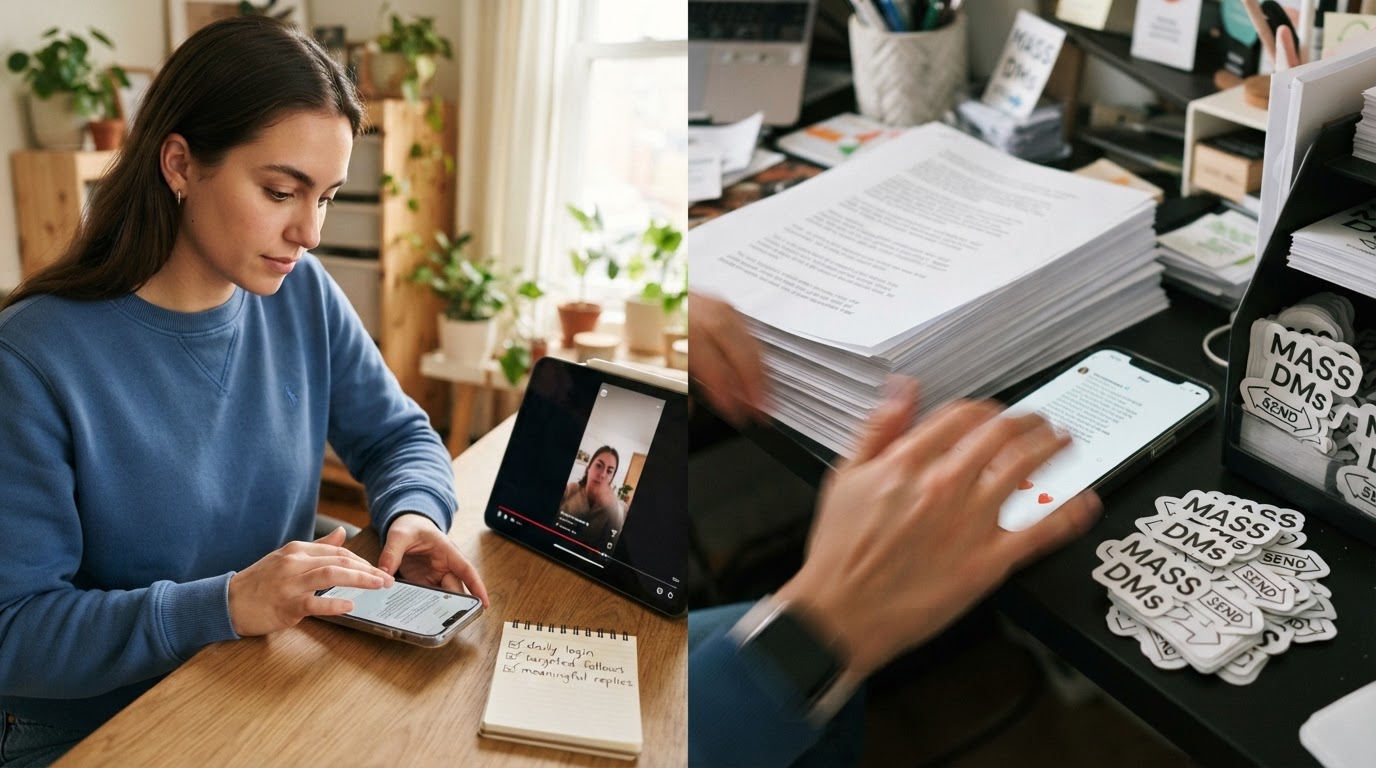
Engagement is where most new accounts go wrong. The temptation to accelerate growth by following hundreds of accounts, liking everything in sight, and commenting the same phrase on fifty posts in a row is understandable. It feels productive. It is also exactly what gets accounts restricted.
Habits That Help
Consistent daily activity. Log in every day, not just when you post. Scroll, engage, check notifications. An account that only shows up when it is posting looks less human than one that interacts with the platform daily.
Targeted follows. Follow accounts that are genuinely connected to your niche. The algorithm pays attention to who follows whom. An account that follows relevant people in a specific category is easier for Instagram to categorize and promote correctly.
Meaningful replies. When someone comments on your post, respond with more than a thank-you. Ask a follow-up question. Reference what they said. These exchanges create a thread that signals actual conversation is happening.
Watching content fully. When you watch a Reel to the end before liking it, that behavior pattern reads differently than rapidly liking videos after two seconds. It is a small thing, but during a warm-up period, small things add up.
Habits That Hurt
Follow-unfollow patterns. Following two hundred accounts in a day and then unfollowing them a week later is one of the oldest spam tactics on the platform. Instagram has become good at recognizing it, and it can trigger restrictions even on older accounts.
Hashtag stuffing. Using thirty hashtags, especially the same thirty every single post, looks like automation. Three to ten relevant hashtags, varied from post to post, work better for reach and look more natural.
Mass DMs. Sending the same message to many people at once, even if you do it manually, is one of the fastest ways to get an account restricted. During a warm-up, keep DMs to responses and genuine one-on-one conversations.
Buying likes or followers. This one should go without saying, but it still needs to be said. Purchased engagement does not fool Instagram's systems for long, and the accounts that deliver those fake followers often trigger spam signals that land on your account, not theirs.
When to Start Running Ads
The most common mistake people make when they have a new Instagram account and a product to promote is turning on ads immediately. The results are almost always disappointing.
A new account with no content history, no engagement record, and no audience signal is hard for Instagram's ad system to optimize. The ad platform needs data. It needs to know who engages with your content, what kinds of users stop scrolling when they see your posts, and how people behave after clicking. Without that data, ads go to broad audiences at higher costs with worse returns.
The general guidance is to wait until after the warm-up period, at minimum two to four weeks, before running paid campaigns. By that point the account has some organic engagement history, the algorithm has started categorizing the account correctly, and the ad system has something to work with.
Some marketers recommend posting organically for a full thirty days before spending on ads. That timeline is conservative but not wrong. An account with thirty days of consistent content and real engagement is significantly easier to optimize with paid spend than an account with three posts and a week of history.
If you are warming up an account specifically to run short-form video ads, understanding how to create UGC ads with AI can help you build a content library before you ever start spending money on promotion.
For app builders who also run on TikTok, the process is similar there too. The guide on how to get 1000 views on TikTok fast covers the early-growth patterns that apply across short-form platforms.
Video: How to Warm Up Your Instagram Account
If you prefer to see the process explained visually, this video walks through the core warm-up steps in a clear, practical way.
And if you want a quicker overview of the mechanics:
Common Warm-Up Mistakes to Avoid
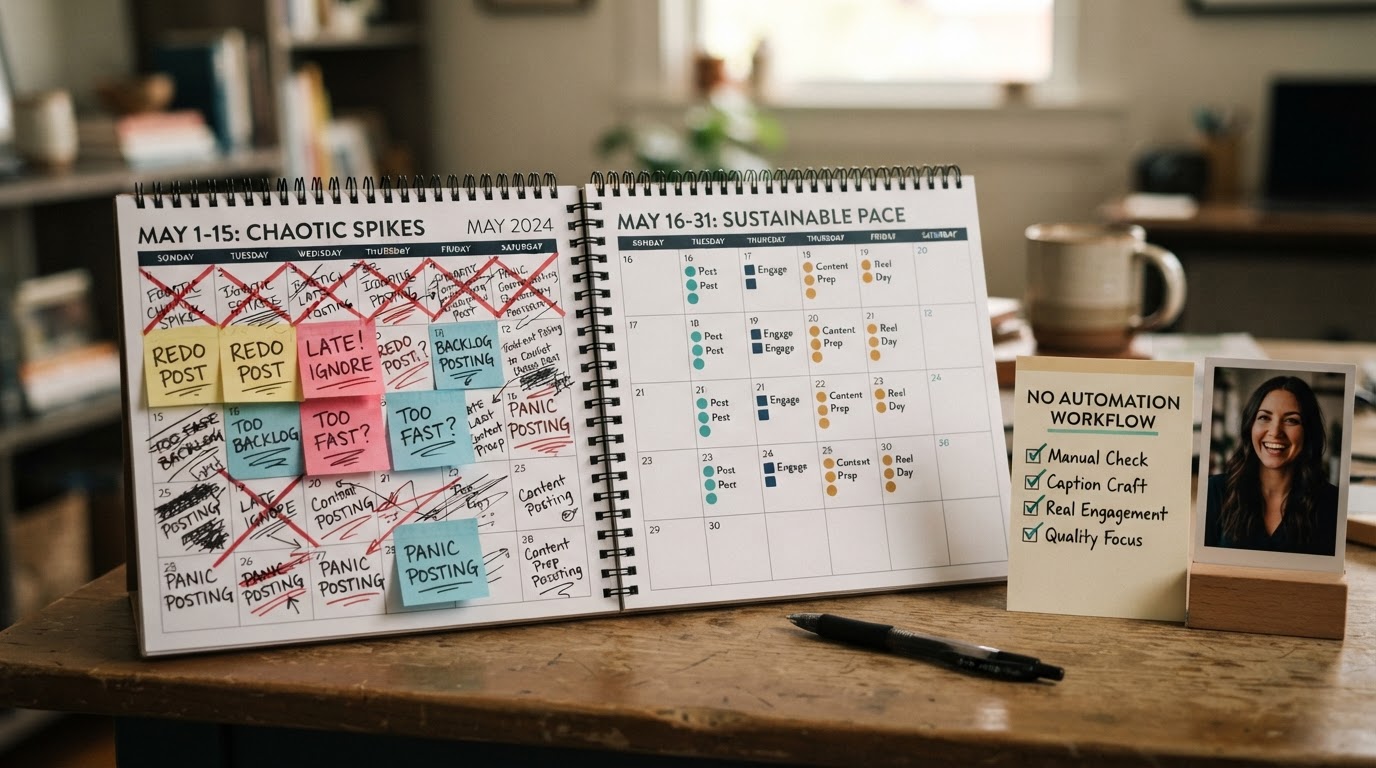
Even people who understand the concept of warming up an account make avoidable errors. Here are the ones that show up most often.
Starting too fast
Posting five times in the first two days and then dropping to twice a week is worse than posting every other day from the start. Consistency matters more than volume. Pick a pace you can sustain, not a sprint that tapers off.
Using automation tools too early
Scheduling tools are fine. Bots that auto-like, auto-comment, or auto-follow are not fine, especially on a new account. Even if those tools avoid detection eventually on an established account, they are nearly certain to cause problems in the first month. Wait until the account is seasoned before introducing any automation beyond basic scheduling.
Ignoring the bio and profile completeness
A new account with no profile photo, a vague bio, and no link looks like a throwaway to both Instagram and the humans who visit it. Completing the profile before the first post is not just cosmetic. It signals legitimacy to the algorithm and makes new visitors more likely to follow.
Switching niches mid-warm-up
Instagram categorizes accounts based on what they post and who engages with that content. Switching from fitness content to tech content halfway through a warm-up period confuses that categorization and can reset some of the trust you have built. Pick a direction and stick with it, at least through the warm-up phase.
Posting nothing but promotional content
An account that only posts ads, discount codes, and product pitches has nothing to offer someone who stumbled onto it for the first time. During a warm-up, mix genuinely useful or interesting content in with anything promotional. This is where the 5-3-2 rule is especially relevant.
How Many Followers Do You Need to Earn Money?
This question comes up alongside warm-up questions because people warming up new accounts are often trying to build toward monetization. The answer is less about a follower number and more about what kind of monetization you are pursuing.
For brand deals and sponsorships, many micro-influencers start landing paid partnerships at 5,000 to 10,000 followers, provided their engagement rate is strong. An account with 8,000 highly engaged followers in a specific niche can charge more than an account with 80,000 passive followers.
For affiliate revenue, the follower count matters less than the trust you have built with your audience and whether your posts drive link clicks. Some accounts generate consistent affiliate income with fewer than 3,000 followers because the audience is tightly aligned with the product being recommended.
To earn around $1,000 per month, the realistic threshold varies significantly. A creator selling their own product or course through Instagram can hit that number with a few hundred followers if the offer is priced well and the audience is the right fit. A creator relying entirely on brand deals typically needs somewhere between 10,000 and 50,000 followers depending on the niche, engagement rate, and how professional their pitch materials look.
The follower count that matters is the one that gets you in front of the right audience, not the biggest audience.
What Comes After the Warm-Up
After four weeks of consistent, intentional activity, the account is ready to operate at a normal pace. That means posting regularly, running ads if relevant, using scheduling tools, and scaling up engagement without worrying about triggering restrictions.
At this point the focus shifts from establishing credibility to building a sustainable content system. For app builders and solo founders, that often means figuring out how to produce enough content to stay visible without spending every day on video editing.
One approach that works well at this stage is batching content, producing several pieces of content in one session rather than creating each one fresh every day. Carousels are particularly good for batching because a single product topic can become five or six slides without much additional work. The post on how ClipStitchr can help grow a mobile app with slideshow content gets into the specifics of how that format works for app promotion.
For short-form video on Reels specifically, the hook-plus-demo format is one of the most repeatable ad structures for product-focused accounts. You can read more about how that structure works in the hook and demo format guide.
If posting to multiple platforms and managing finished ad content is becoming a bottleneck, tools like Post-Bridge can handle the scheduling and distribution side once the content is ready to go.
And if you are comparing workflow options for creating short-form video ads, the post covering UGC ad creation and short-form video workflow alternatives covers what others in the same situation have tried.
A Quick Reference: What to Do and When
Here is a simple timeline to keep nearby during a warm-up:
Day 1 to 3
- Complete the profile fully
- Follow 10 to 20 relevant accounts
- Engage with content but do not post yet
Day 4 to 7
- Post once a day or every other day
- Use 3 to 5 relevant hashtags
- Comment genuinely on 5 to 10 posts per day
- Follow 5 to 10 new accounts per day
Week 2
- Post daily if content is ready
- Reply to every comment and DM
- Engage with 10 to 15 posts per day
- Begin watching reach and engagement metrics
Week 3 and 4
- Continue daily posting and engagement
- Follow up to 20 to 30 accounts per day if relevant
- Begin light ad testing if the account has consistent engagement history
After Week 4
- Run ads at a normal pace
- Use scheduling tools if needed
- Batch content to maintain consistency without daily editing sessions
Final Thoughts

Warming up an Instagram account is not complicated, but it does require patience. The accounts that skip this step tend to either stall out with no reach or get restricted before they have posted anything meaningful. The accounts that go through it carefully tend to find that growth becomes easier afterward because the algorithm has a positive signal to work from.
The work is not glamorous. It is logging in every day, posting real content, leaving actual comments, and resisting every shortcut that promises to speed things up. But the payoff is an account that Instagram treats as legitimate, which is the only starting point worth building from.
If you are an app builder or solo founder producing short-form content for Instagram or Reels ads, ClipStitchr is built to handle the batching and editing workflow once your account is ready to start posting at scale. You bring the hook clips and the product demo. The tool produces finished vertical ads ready to review and post, without rebuilding the same editing workflow every week.